On 27 October 2026, Regulation (EU) 2026/2359 amending the EU rules on the coordination of social security systems was published in the Official Journal of the European Union. The reform concludes the long-running legislative work on amendments to Regulations No 883/2004 and No 987/2009 and is relevant, among others, to individuals who pursue activities in two or more Member States.
We have previously discussed the rules for determining the applicable legislation where work is performed in several EU Member States in our article “Working in multiple EU countries: European Parliament adopts changes to EU social security coordination rules”. The current reform amends and clarifies certain rules relevant to cross-border working arrangements.
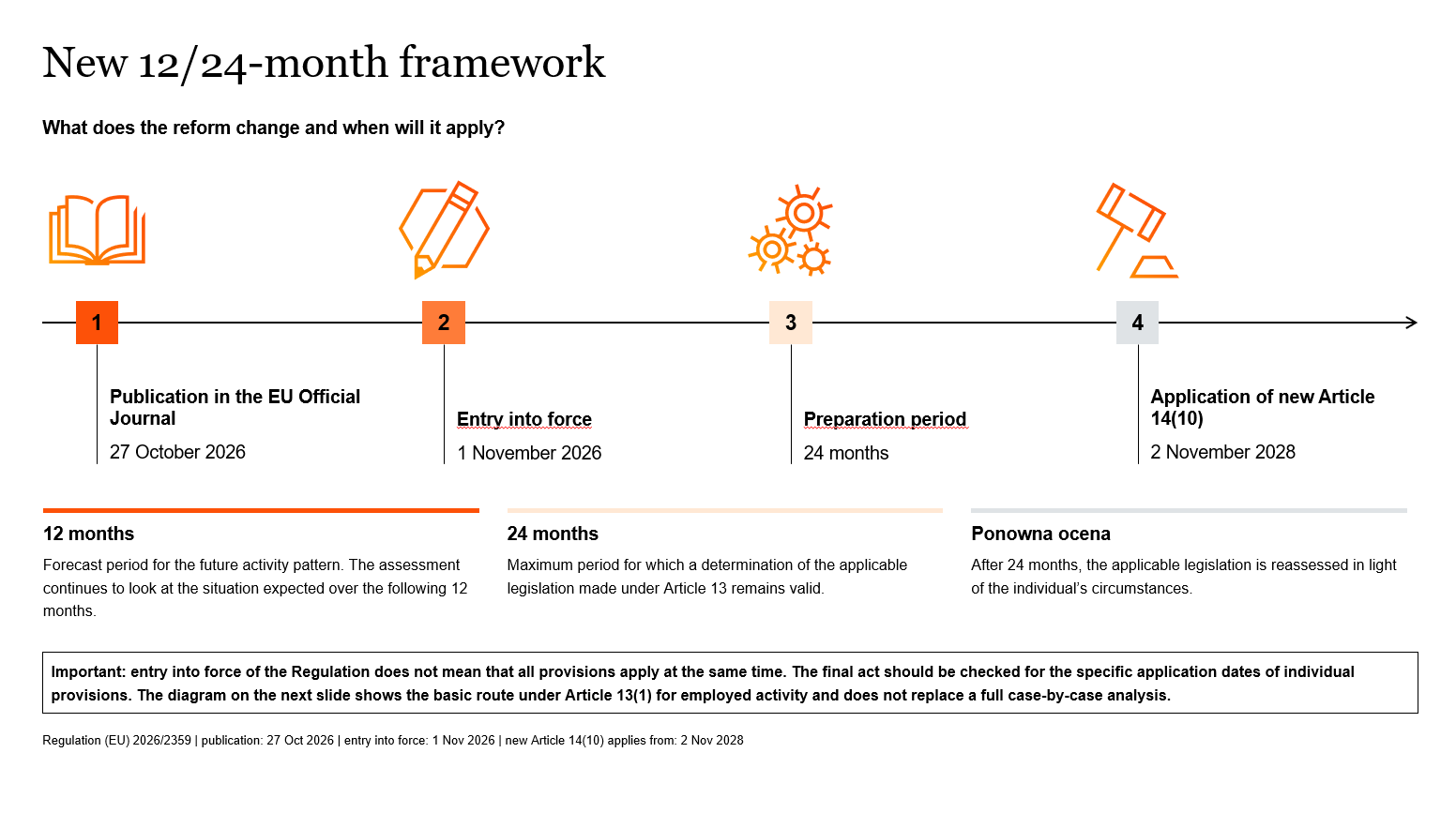
The new Regulation entered into force on 1 November 2026. However, not all of its provisions will apply from the same date. A transitional period has been provided for certain rules, and the new wording of Article 14(10) of Regulation No 987/2009 will apply from 2 November 2028.
What changes for individuals working in several Member States?
One of the relevant changes is the clarification of the rules for determining the applicable legislation for persons who normally pursue employed activity in two or more Member States under Article 13 of Regulation No 883/2004.
The new Article 14(10) of Regulation No 987/2009 introduces an important distinction between the 12-month forecast period and the maximum 24-month period for which a determination of the applicable legislation remains valid.
In practice:
- 12 months remains the period over which the individual's expected circumstances and activity pattern are assessed;
- 24 months is the maximum period for which a determination of the applicable legislation made under Article 13 remains valid;
- after 24 months, the individual's circumstances and the applicable legislation should be reassessed.
(click on the picture to enlarge)
(click on the picture to enlarge)
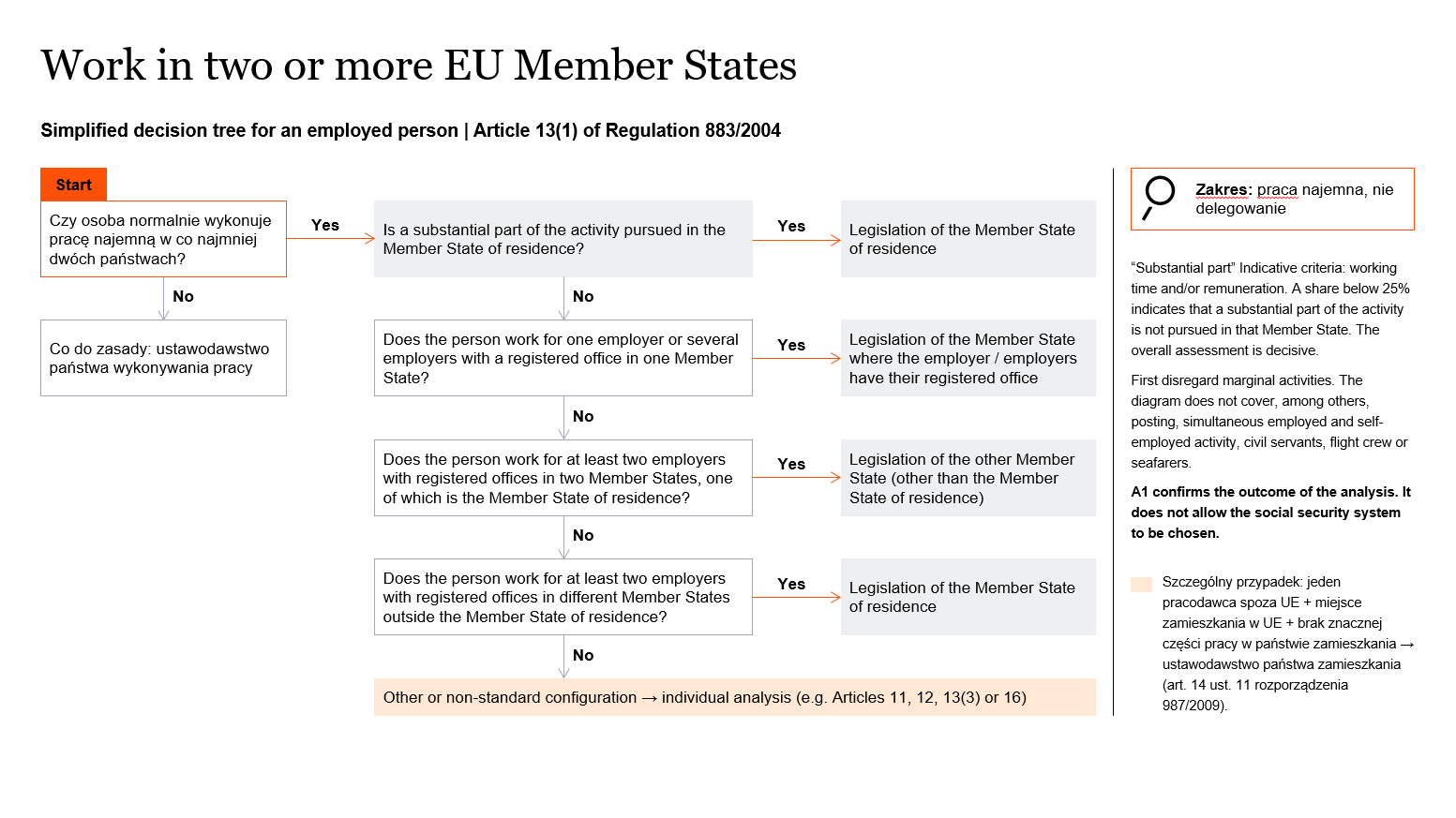
The graphic also presents the basic route for determining the applicable legislation for a person pursuing employed activity in at least two Member States. The analysis takes into account, among other factors, the Member State of residence, the extent of activity pursued in that Member State and the Member State or Member States in which the employer or employers have their registered office.
Entry into force does not mean that all changes apply immediately
From an employer's perspective, it is particularly important to distinguish between the entry into force of the reform and the date from which particular provisions apply.
The Regulation entered into force on 1 November 2026, while certain new rules will apply only after a transitional period. In the case of the new Article 14(10), this means that it will start to apply from 2 November 2028.
This does not mean that the reform is irrelevant until then. The new Regulation includes a broader package of amendments to the EU social security coordination rules, and individual provisions have different application dates. When assessing a particular case, it will therefore be necessary to determine not only which provision applies, but also from which date it should be applied.
What does the reform mean for employers?
The two-year period before certain new rules start to apply gives employers time to prepare for the changes.
In particular, employers may wish to use this period to identify individuals who:
- regularly work in two or more EU Member States;
- use cross-border remote-working arrangements;
- hold A1 certificates related to activities pursued in several Member States.
For these cases, it may be useful to review, among other things, the employee's Member State of residence, the proportion of activity pursued in individual Member States, the location of the employer or employers and the way in which the agreed working arrangement is documented.
The publication of the reform does not in itself mean that existing social security arrangements or current A1 certificates need to be changed immediately. It does, however, provide a good opportunity to identify groups of employees who may be affected by the new rules and establish when particular changes will become relevant to them in practice.
PwC comment
In practice, the correct distinction between different cross-border working models remains crucial. Different rules may apply to a person who normally works in several Member States, to an employee who is temporarily posted to another Member State, or to more complex patterns of professional activity.
An A1 certificate confirms the applicable legislation resulting from the EU coordination rules. It does not provide a mechanism for freely choosing the social security system to which an individual will be subject.
Employers may therefore wish to use the preparation period to review existing cross-border working arrangements and the processes used to determine the applicable legislation and obtain A1 certificates.
Autorzy: