The 2026 Polish income tax return will not be filed until 2027. However, for some tax reliefs and deductions, filing the return is only the final step. Eligibility may depend on an expenditure, contribution or donation actually made in 2026 and on having the appropriate supporting documentation.
The topic has become even more relevant following the President’s signing, on 18 November 2026, of the Act of 22 October 2026 amending the Personal Income Tax Act, the Corporate Income Tax Act and the Act on Lump-Sum Income Tax on Certain Revenues Earned by Individuals, processed as draft UD461 (Sejm paper No. 3149).
The signed Act introduces changes to selected tax reliefs, including the abolition of the Internet relief and the expansion relief, an increase in the deductible value applicable to blood donations and an extension of the robotics relief.
Before year-end, it is therefore worth considering tax preferences from two perspectives: which reliefs and deductions may be claimed in the 2026 settlement and what will change from 2027.
Do not wait until the tax return is filed
Year-end is a good time to review the tax reliefs and deductions that may be available in the annual PIT settlement. This allows taxpayers not only to identify available preferences, but also to determine whether any action still needs to be taken or documentation completed before 31 December.
IKZE is a good example. In the 2026 settlement, contributions actually made during the year may be deducted up to PLN 11,304, or up to PLN 16,956 for individuals carrying on non-agricultural business activity. Only contributions actually paid and properly documented are deductible.
First determine the source of income, then the relief
The name of a tax preference alone does not determine whether it can be applied. The method of taxation and the type of tax return filed are also relevant.
Some deductions are available for income taxed according to the progressive tax scale, others for income subject to the 19% flat tax, while certain deductions may also be available to taxpayers subject to lump-sum tax on recorded revenue.
For this reason, the article includes a practical overview of selected reliefs and deductions for 2026, divided into tax reliefs and income / revenue deductions. For each item, the overview indicates the PIT-36L, PIT-28, PIT-36 and PIT-37 forms in which the relevant preference may apply.
The overview is intended as a general guide. The availability of each relief should be assessed against the individual circumstances of the taxpayer.
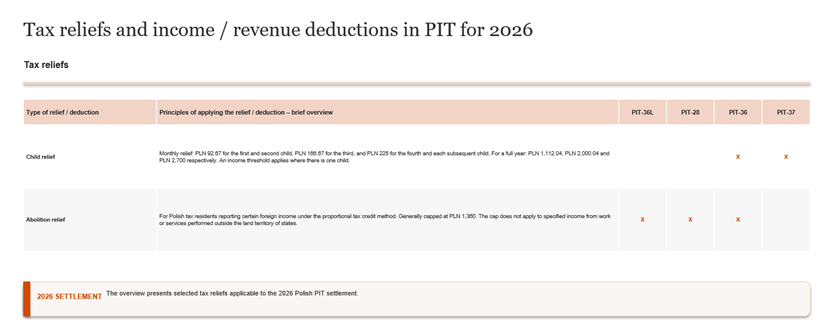
Selected tax deductions in 2026 (click on the picture to enlarge)
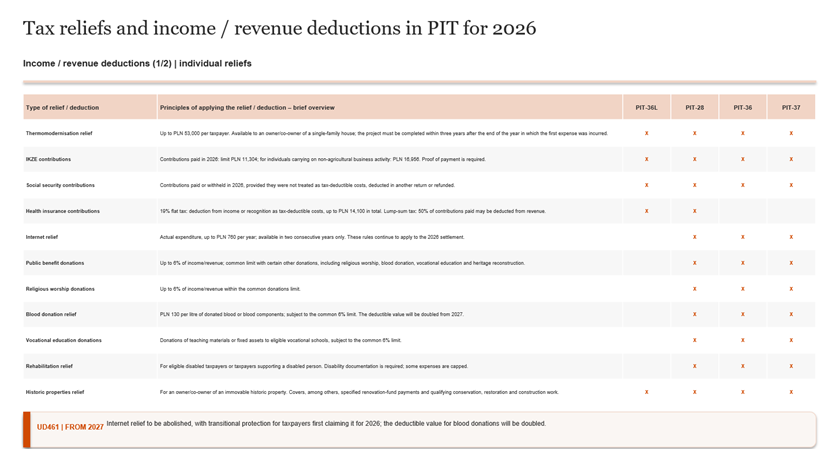
Selected income deductions in 2024 (click on the picture to enlarge)
Donations: a common limit, different rules
Many donations, including donations for public benefit purposes, religious worship, blood donations and vocational education, are subject to a common limit of 6% of income or revenue.
Separate rules apply to donations for the charitable and welfare activities of Churches. Regardless of the category, the relevant beneficiary, the purpose of the donation and appropriate documentation confirming the donation remain important.
Documentation may determine whether a deduction is available
In practice, the nature of the expenditure alone is not sufficient. Supporting documents may include bank transfer confirmations, invoices, certificates, evidence of IKZE contributions or documentation confirming the value and purpose of a donation.
It is worth collecting the relevant documentation before the tax filing season begins, particularly where a taxpayer intends to claim several preferences at the same time.
Changes to tax reliefs from 2027 – Act signed by the President
The Act signed on 18 November 2026 introduces changes to selected tax reliefs that should already be taken into account when planning for the next year.
Internet relief
The Internet relief will be abolished. This does not affect the possibility of claiming the relief in the 2026 settlement, provided the taxpayer meets the currently applicable conditions.
Transitional protection is also provided for taxpayers who claim the Internet relief for the first time in their 2026 settlement. Those taxpayers will retain the possibility of making their second deduction for 2027.
Blood donation relief
The value attributed to donations made by honorary blood donors for deduction purposes will also change.
For the 2026 settlement, the existing value of PLN 130 per litre of donated blood or blood components continues to apply. From 2027, the value taken into account for the purposes of the deduction will be doubled.
Robotics relief
An important change concerns the robotics relief. 2026 will no longer be the final year in which this preference is available.
We have previously discussed the planned extension of the relief and the rules governing its application in our article “The robotisation tax relief is set to stay longer. What do the new tax proposals mean?”
The Act signed by the President confirms that the relief will be extended through the end of the tax year beginning in 2036 and clarifies the rules concerning the treatment of depreciation write-offs.
The remaining conditions for applying the relief generally remain unchanged. Eligibility therefore continues to require verification of the nature of the costs incurred and compliance with the relevant statutory requirements.
For businesses planning further investment in robotics, the change primarily provides a significantly longer time horizon for using the preference.
Expansion relief
The opposite approach has been taken in relation to the expansion relief. This preference will be abolished from 2027.
The transitional provisions nevertheless allow qualifying costs incurred before 1 January 2027 to continue to be settled under the existing rules.
From a 2026 year-end perspective, correctly identifying when a qualifying cost was incurred and retaining documentation confirming that the relevant statutory conditions have been satisfied will therefore be particularly important.
For businesses, the year-end review may also be a good opportunity to revisit tax preferences related to their business activity, in particular the R&D relief, where the correct identification and documentation of qualifying costs is particularly important.
What should be checked before the end of 2026?
Before year-end, taxpayers should in particular:
- check whether any planned IKZE contributions have actually been made in 2026;
- review donations, their beneficiaries and purposes, as well as the common 6% limit;
- collect invoices, proof of payment, certificates and other documentation required for particular reliefs;
- determine the source of income or revenue and identify the tax return in which a particular preference may be claimed;
- where the Internet relief is to be claimed, verify that the conditions for claiming it for 2026 have been met;
- for businesses, verify whether the R&D relief may be available, including the correct identification and documentation of qualifying costs, as well as other preferences such as the robotics relief, prototype relief, sponsorship relief and payment terminal relief;
- in the case of the expansion relief, establish which qualifying costs were incurred before 1 January 2027.
PwC comment
Tax reliefs and deductions are worth reviewing before year-end. For some preferences, filing the annual PIT return is merely the point at which a right that arose earlier, as a result of incurring expenditure, making a payment or satisfying other statutory conditions, is reported.
The signing of UD461 also makes the 2026 settlement an important transition point for certain preferences. This applies in particular to the Internet relief and the expansion relief. At the same time, the extension of the robotics relief provides businesses with a longer horizon for planning qualifying investments.
The end of 2026 should therefore be considered from two perspectives: making appropriate use of the reliefs available for the 2026 settlement and preparing for changes that will become relevant from 2027.
Autorzy: